


Why Most Strategy Presentations Fail (And How Leaders Fix Them)
Submitted by Jack Milner on March 10, 2026
I was reading a Bernard Cornwell novel from the Sharpe series recently. Most of the action is set during the war between Britain and Denmark in 1807. On the way back from Copenhagen, the characters sail past Elsinore – the castle from Hamlet.
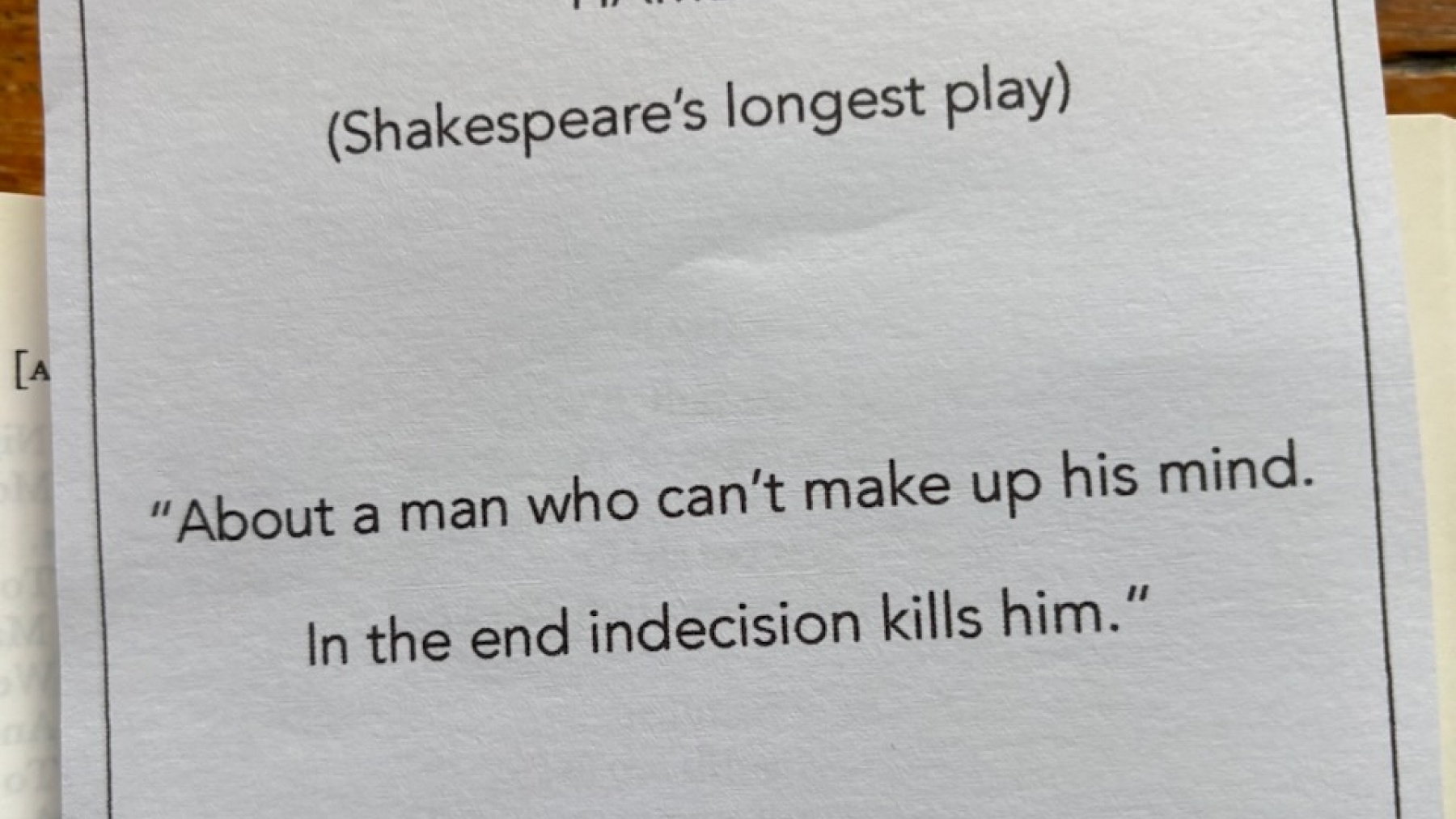
The ebulliant Captain Chase asks Sharpe if he knows what the play is about. Sharpe says he doesn’t. Chase bluffly replies, “It’s about a man who can’t make up his mind. In the end, indecision kills him.”
That is an extraordinarily brilliant piece of simplification. Bernard Cornwell has basically summarised one of the greatest works of world literature in a single sentence. And it works.
Simplification is one of the hardest things to do when presenting.
Among my clients it’s always one of the top requests. The question comes in different forms, but it’s the same issue:
“How do we simplify our messaging?”
“Our message isn’t landing.”
“We’re drowning in data.”
“When we present to senior stakeholders and the key point gets lost.”
You see the same problem in boardrooms. Huge decks. Endless slides. Information delivered quickly. Somewhere in there is the important message, but it gets buried, usually in slide 47, bullet point 4.
And when it comes to strategy presentations, simplifying something genuinely complex is one of the hardest jobs a leader has.
Mark Twain once wrote a very long letter to a friend and apologised at the end saying, “I would have written you a shorter letter if I’d had more time.”
The truth is simplification is hard work.
I’ve been lucky enough to work with some superb presenters. The very best all share one ability: they simplify the complex.
My comedy co-writer Mark Stevenson works with some of the world’s leading environmental science organisations. One of his great gifts is taking incredibly complicated ideas and explaining them so everyone in the room understands what’s going on.
The same was true of Danny Wardle, a brilliant sales director I worked with. Danny used to sell extremely complex AI-driven software, yet in meetings he could boil it down so a customer understood it in seconds.
No jargon. No waffle. Just clarity.
It’s a rare skill.
The good news is it can be learned.
Before I share three simple techniques, let me tell you a story about Steve Jobs.
There’s a brilliant moment described in John Steel’s book Perfect Pitch. Steel recalls being in a meeting where Apple’s marketing team delivered a typical corporate one-hour presentation: lots of slides, lots of detail, and not entirely clear what the point was.
Then Steve Jobs walked in.
Apparently he was fairly rude about the presentation (politeness was not one of his qualities). He went to a whiteboard and drew a grid of Apple’s products of which there were about sixteen of them.
Then he crossed out thirteen.
“We’re focusing on these three,” he said.
He explained the strategy in about ten minutes.
Steel said it was the best presentation he’d ever seen.
So here are three quick ways you can do the same.
First: imagine someone in your audience explaining your message to a colleague afterwards.
Chase’s one-sentence description of Hamlet works because it’s something Sharpe could easily repeat to another soldier.
Your message should pass the same test. If someone left your meeting and said, “Here’s what they’re trying to do…”, what would that sentence be?
Second: imagine you’re explaining it to a room full of twelve-year-olds.
The theatre director Peter Brook once invited a group of twelve-year-olds to watch rehearsals of Hamlet. He simply observed when they became bored.
The next day he told the cast, “We have a problem. This play is boring.”
They reworked it. That production is now considered one of the greatest ever staged.
If twelve-year-olds can’t follow it, adults probably can’t either.
Third: use the rule of three.
When in doubt, break your idea into three points. Three priorities. Three actions.
Our brains like threes. They’re easier to understand and easier to remember.
And if you can get your message down to three things, you’re already halfway to clarity.
If you’d like to see some of these ideas in action, I’m running a face-to-face Executive Presentation Masterclass Taster on May 20th. It’s a practical session where senior leaders work on simplifying their message, sharpening their storytelling, and making presentations far more memorable.
You’d be very welcome to join us.